

Special Edition - MAHA ELEVATE Program NOFO Debrief
Basically Funding Use Cases That Will Produce

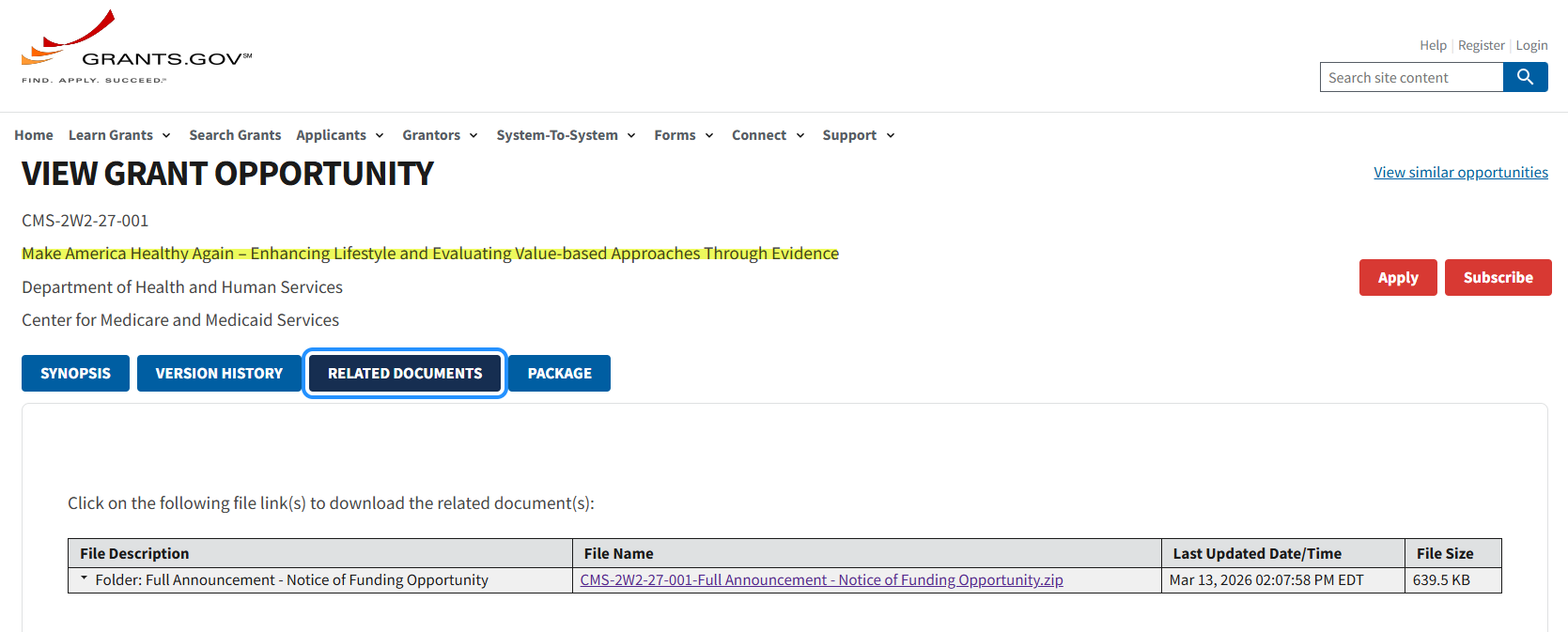
Before you read further, please note, this dropped at 3:30pm today, Friday. It’s a mere 7 hours later and we’ve dove in, contemplated, written, reviewed, consulted our AI agents and done our best to avoid typos. Have grace, getting this out quickly trumped ensuring perfection.
We’ve all been waiting anxiously for the MAHA ELEVATE NOFO (Notice of Funding Opportunity) aka the details of the until now mythical new CMS program promising $100M in new funding for a type of healthcare delivery that until now was basically not viewed as actual healthcare. Funding that will be granted to ~30 organizations.
We wrote about it back in December when CMS was basically giving us their own version of the “12 Days of Christmas” by dropping new programs on the daily. While I as trying to be on holiday with family in Germany no less. Not that I’m bitter or anything.
Well today is our lucky day. Friday, not at 5, but close. Right around what some would consider Happy Hour, they dropped the much anticipated great white hope. Hopefully the fact that it’s Friday the 13th isn’t some type of strange harbinger.
No Food Is Medicine For You (Insert Seinfeld “No Soup For You”)
While ELEVATE points to “Root Causes” explicitly in the language, they are also explicitly NOT going to pay for food through ELEVATE. The NOFO states funding is intended to address ”root causes of illnesses” while saying “funds cannot be used for food, meals, or vouchers.” That contradiction is not a mistake.
Instead it’s focused on is addressing the infrastructure gap Carter Williams and I have been mapping for two years. It is the architecture. Understanding it is the whole game.
That’s it. That’s the whole story. The federal government just mainstreamed the language we’ve been using for two years - and drew an explicit line around the thing most directly responsible for those root causes.
While we both support Food Is Medicine, it’s an intervention deployed and dependent on System B in its current form.
We are advocates of Food Is Health which fixes the disconnect between upstream and downstream systemically. We aren’t asking for downstream healthcare to pay for upstream mechansims.
What ELEVATE can do through the right program is fund the pipes and demonstrate the human health outcomes of allowing those downstream in the healthcare system to move back to health using upstream tools. And ultimately reverse a disease and convert that patient back into a consumer and enable them to remain healthy upstream. And honestly, if you follow that, you can understand quite quickly why the incumbent healthcare system has never really adopted lifestyle medicine.
As a value-based care, payment transformation evangelist and past underwriter/actuary, I’m well aware at the arguments against this position. But that same technical expertise also gives me the context as to why monetizing and managing chronic disease is a much simpler path to revenue growth and the current SV investment thesis/playbook than moving downstream to upstream.
I’ll save more of that for our upcoming livestream with our friend Gen Gillsepie at the end of March.
What We Already Knew
Most will talk about MAHA ELEVATE as a standalone program. Technically speaking it is.
But from our System C perspective, it sits alongside CMS’s ACCESS/TEMPO models and the new LEAD program - three programs that together signal CMS is opening a coordinated experimentation window for upstream interventions.
This isn’t one program. It’s a pattern. And the pattern is: CMS knows the current system is on course to bankrupt the Medicare trust fund and is therefore starting to fund evidence that something else works. A stacking opportunity that if we had more time by now we would have articulated. We are already back to establishing an ACO for 2027 as part of a stacking project
We knew ELEVATE was coming. In December we knew it was for lifestyle medicine. For Medicare FFS beneficiaries with chronic conditions - the highest-cost, highest-need segment of a system hemorrhaging money on preventable disease. For programs that were established and demonstrating outcomes. $100M total, 30 awards, up to ~$3M each, two cohorts (October 2026 and 2027), 3 awards specifically reserved for dementia.
And yet somehow we found ourselves in regular conversations with healthcare incumbents who have all but snubbed their noses at lifestyle medicine speaking about ELEVATE as if they could swoop in and collect $3M like it was passing GO on a Monopoly board.
It’s no secret how outspoken and how much of an advocate I in particular have been for the last 2.5 years about Lifestyle Medicine and Whole Person Care only to face roadblocks from CFOs and Population Health leaders across the country asking for more evidence that disease could be reversed. So those incumbent conversations about ELEVATE were a bit like a slap in the face.
What we didn’t know before today were the details of the program. That’s what the NOFO actually reveals.
It’s no mistake that CMS/CMMI released the NOFO right after two weeks of private closed door sessions with a number of leaders I talk to regularly that are key constituents in this space. It was inevtiable.
What’s New From the NOFO
Randomization is required. Not encouraged. Required. No randomization plan = no award. This is the single most important line in the document. ELEVATE is not a service-delivery program. It is not value-based care with a yoga class attached. It is an evidence-generation program - CMS is funding the “proof” that it’s possible to move upstream and that it works, not the interventions themselves. More on what that means in a moment.
Deadlines. Round 1 applications. LOI deadline: April 10, 2026 - required, not optional. Informational webinar: March 25. Application deadline: May 15. If you miss Round 1 you can reuse the application for Round 2.
This is a cooperative agreement, not a grant. CMS is an active partner throughout the award period - they are not writing checks. Milestone accountability is required. This is not your “Fathers CCM program”. What you commit to in the application is real, ongoing, and there are actual consequences for missing it.
Case in point, 60% of disbursements are tied to operational milestones. Miss one and you forfeit all future disbursements from that tranche. 40% tied to enrollment - miss 20% of your minimum target at 20 months, and CMS can terminate the award. Miss 65% at 32 months, same result. And dropouts don’t count. A beneficiary only counts if they enroll, are confirmed as eligible Medicare FFS by CMS, and complete the full program. Again, nothing like programs of Christmas past.
This isn’t built to fund Food Is Medicine programs - I know a number of our friends will be frustrated, we get it, but this program isn’t designed to support upstream interventions that we already know work and that have been scaled. The NOFO is clear - "“Federal funds cannot be used for meals, food, or vouchers”. CMS explicitly permitted “other funding sources.” BUT, they require nutrition as an intervention component. It’s the infrastructure, not the food. And honestly after the heart breaking conversation I had a week ago with someone at their Food Is Medicine program graduation celebration where she told me after the graduation she would be going back to the same diet that made her sick because she couldn’t access what healed her, it is clear that Food Is Medicine is a short-term intervention and that we need a systemic solution that starts from food itself. CPG, grocery, SNAP, food banks, soup kitchens - they all need to be a source of affordable, accessible nutrition, not simply cheap calories.
This is where Food Is Health begins. This is the gap we’ve been screaming about for two years. That gap now has a federal funding program on one side of it. The other side still needs to be built.
Non-clinical entities can apply. With the right clinical partner. The provide some examples int he NOFO, but non-clinical is just that. It’s wide open. After hearing about some of the closed door conversations, it’s clear CMMI is open to anything. This non-clinical element is deliberate. CMS is not looking for more hospital systems. They want organizations that have built the upstream infrastructure - that have actually connected the dots between food and lifestyle on one side and chronic disease outcomes on the other - and can prove it.
That’s why I will say here what I said on LinkedIn, yes we will pull together one or multiple Food Is Health applications of use cases leveraging the trusted solutions that have demonstrated results to create upstream infrastructure many have yet to contemplate. That is why we have created this tribe of Food Is Health. A tribe rich with the very solutions CMMI wants to see come together to prove upstream generates REAL health outcomes. That chronic disease can be reversed and not simply managed and treated.
The American College of Lifestyle Medicine’s six pillars are now the federal framework. Nutrition, physical activity, sleep, stress management, social connection, substance avoidance. Not miscategorized as a wellness pitch deck instead of the evidence based medicine it truly is and has been. The official structure of a $100M federal program. That mainstreaming has consequences beyond ELEVATE.
“Root causes” is finally getting it’s day. This alone has me jumping for joy! “Upstream disease management” is in. Although I love disease reversal even more. MAHA is operating from a different language stack, and that will propagate forward into every subsequent CMS model, state Medicaid plan, and Congressional framing that cites this document. Pay attention to what language gets normalized. And yes, I realize it might not stick, but when you have multi-year programs being implemented before the mid-terms, it’s hard to argue they won’t be here for more than a hot second. While I appreciate the importance of health equity, I’m grateful we are leaning into outcomes based interventions. The same ones that work best for health equity but are required to show the evidence of improving outcomes as opposed to simply checking a box of care delivery. Many times leading to simply additional revene for someone monetizing disease. Not changing the lives of those in need of health itself.
Three of thirty awards are reserved for dementia and cognitive decline. If your population or evidence touches cognitive health, you’re in a smaller, less crowded pool.
The scoring rubric (more details in section further below). 100 points: FLM Intervention Design gets 45 (15 of those are your evidence base - RCT preferred, 1,000+ participants preferred). Beneficiary Recruitment & Study Design gets 20 (randomization is a hard disqualifier if absent). Organization, Administration & Capacity gets 15. Data Management Plan gets 10 (2 points just for having CEHRT). Budget Narrative gets 10. Prior FLM experience with outcome data is a listed eligibility requirement — not a preference. If you don’t have it, you may not clear initial review.
Thirty awards is insanely competitive. Scoring 65 points may not be enough if the pool is strong. The organizations most likely to win are those who can credibly demonstrate all five scoring dimensions right now and have been making it clear why what they are doing is what everyone should be doing for quite some time with the message falling sadly on deaf ears.
Merit review isn’t the only factor. This is where FQHCs in particular may have a crack in the door. CMS explicitly reserves discretion to weight geographic and project-type portfolio balance across 30 awards.
If you don’t have peer-reviewed outcomes data with 1,000+ participants and credible access to 2,000+ Medicare FFS beneficiaries, you are eligible on paper and uncompetitive in practice. Technically eligible and practically competitive are not the same thing. Like I said, this program is very different.
Who This Is Really For
The NOFO’s open language masks a fairly narrow competitive profile. The likely winners are organizations that already combine clinical credibility, measurable outcomes, beneficiary access, and trial-grade operational discipline. But the *path* to winning looks different depending on where you’re sitting.
Let’s start with healthcare incumbents…
Health system, ACO, FQHC, academic medical center, integrated medicine practice you may think you are a natural fit. Don’t assume you win, this one is VERY different.
The eligibility bar you clear that others don’t: demonstrated prior integration of whole-person lifestyle medicine into conventional care, with documented improvements in health, quality, and costs.
I’ve been deep in this space professionally for multiple years now and this is exactly what clients were unwilling to deliver. The incumbents that meet these qualifications are very few and far between.
IF you’ve been running a lifestyle or integrative medicine program and tracking outcomes, you may have exactly what CMS needs. If you haven’t been tracking outcomes systematically, you’re in the same boat as everyone else.
Your structural advantages are real: Medicare enrollment, CEHRT, existing patient panels, IRB infrastructure, federal grant management history. These matter for both scoring and discretionary selection.
Here’s where most health systems will get this wrong: ELEVATE explicitly requires at least one service not currently covered by Original Medicare. CMS is not writing a check to validate your existing revenue streams. They want the upstream layer. The layer virtually every service line oriented health system in the country has been loathe to investing in because they could never see an ROI.
The nutrition, behavioral, community-based programming that sits outside your current billing model. If you treat this like a conventional care-management pilot with a wellness veneer, you’ll miss the point and probably miss the award.
What you need before you apply: the actual lifestyle medicine delivery layer if you haven’t built it, the non-clinical community infrastructure to reach patients where they live, and a food financing partner for the component CMS explicitly won’t pay for.
Let’s move to startup or non-clinical operator.
Digital health company, CBO, wellness platform, lifestyle medicine spinout, tech-enabled care delivery org
You’re explicitly named in the NOFO. CMS listed you. That’s real, and unusual.
Here’s what that doesn’t mean: that the bar is lower. The evidence requirements, beneficiary access requirements, and randomization requirements are identical for you. If your evidence base is a small pilot, your enrollment capacity is under 2,000 Medicare FFS beneficiaries, or you have no randomization plan, you are eligible on paper and uncompetitive in practice.
What makes you competitive is the same thing that makes System C matter: you sit closer to where patients actually live than hospitals do. If you’ve built program infrastructure that genuinely moves people upstream - real engagement, real retention, real community access - and you can attach that to a clinical partner with outcomes data, you have something CMS can’t get from a health system alone.
The partnership architecture IS your application. We can help you sort that out, that’s where we have been living and breathing in Food Is Health. That’s our tribe.
If you’re a food incumbent - food manufacturer, retail food company, agricultural producer, food-as-medicine platform, food tech company
You’re probably reading this thinking it doesn’t apply to you. You’re wrong.
The food prohibition - federal funds cannot pay for food - looks like an exclusion.
It’s actually a signal. CMS is building 30 organizations that will be delivering nutrition interventions to Medicare beneficiaries, running randomized trials, and tracking clinical outcomes over three years. That is a federally sponsored evidence environment. And the food financing that makes those interventions work is explicitly not covered.
Help them make it successful and unlock a througline to upstream revenue.
That gap is yours.
The organizations that win ELEVATE awards in October 2026 immediately become your most strategic partnership targets. A food company with a health-positioned product line, a produce-rx infrastructure, or a food-as-medicine delivery capability has a direct path into a federally tracked clinical trial - as a co-funder of the intervention layer, not a grantee. Your products participate in the evidence generation. Clinical outcome data comes back to you. None of that requires CMS to reimburse your product directly.
The opportunity is not “becoming a healthcare provider.” It is becoming a credible partner in the intervention layer and tying product participation to measured clinical outcomes. That’s a strategic position that until now was unfunded, unacknowledged and undefined. Now it’s independent of whether ELEVATE scales into coverage.
The window opens in October 2026. Start mapping potential awardees now.
So What?
A lot of people are going to read ELEVATE as a “lifestyle medicine funding program” and position accordingly. That framing is incomplete and will lead to weak applications.
ELEVATE is not CMS paying to deliver System C at scale. It is CMS paying to “prove” that pieces of System C work under controlled conditions - so it can justify future coverage expansion.
It takes evidence for policy to shift system design.
Prove it → justify coverage → create the category.
ELEVATE is step one. CMS isn’t ready to write a coverage policy for lifestyle medicine. They don’t have the evidence base at scale and rigor. So they’re funding the evidence generation. The 30 awardees are, in effect, running the trials CMS needs to make the case for what comes next.
This reframes competitive positioning entirely. If you’re a lifestyle medicine organization with existing outcomes data, you’re not just an applicant - you’re a potential principal investigator in a federally sponsored trial. If you’re a non-clinical entity with program infrastructure but no peer-reviewed evidence, your first job is finding the partner who has it.
It also reframes the timeline. This isn’t “run a program for three years and move on.” The evidence ELEVATE awardees generate will feed directly into CMS coverage decisions. The organizations that win awards and produce strong results will be positioned — not guaranteed, but positioned - for whatever CMS does next. The stakes extend well past the award period.
What We Are Focused On Executing
The food financing gap is now officially documented.
CMS required nutrition. CMS won’t fund food. That’s the structural gap where infrastructure gets built.
ELEVATE awardees need a mechanism to fund the food component outside federal dollars. That’s a private-sector opportunity, and it’s also where food companies, foundations, and impact capital can play a legitimate and durable role. This is the architecture moment we’ve been describing for two years.
Partnerships & Matchmaking - The NOFO is written for applicants that mostly don’t exist yet - organizations that combine clinical credibility, patient access, delivery capability, and evidence infrastructure in one application-ready entity. Most single organizations don’t have all four. The organizations that assemble the right partnerships in the next 60 days will be at the table. We’re already working on this.
Food Is Health Application(s) - We’re open to anything here. ELEVATE allows Cohort 1 applications to be reused for Cohort 2 (2027). A strong application isn’t wasted if you miss the first window. We’re looking for the use cases.
AI simulation - We are already building the scheematic for a model that runs your organization’s profile against the CMS scoring rubric - evidence-based, population access, organizational capacity, data infrastructure. More to come.
This post is not finished thinking.
We will provide a Part II that does more of a deep dive into the scoring rubric and is more thoughtful for those looking to apply. Food Is Health is actively working the application question. We’re building partnership architecture, developing the AI scoring simulation, and mapping the food financing gap in detail. We’re open to multiple applications across distinct partnership configurations.
And dear friends, Part II will be for our paid subcribers. Because it’s time that level of insight be supported with a measily $200/year (a few coffees a month) for that type of work. Work that we produce on a regular basis and until now have not been particularly disciplined about putting up a paywall.
Pleaese let us know what would be valuable in Part II.
In the meantime, if you thinking about applying don’t delay. The next 30 days matter more than you think. The informational webinar on March 25 is worth attending. And yes, we will make sure to summarize it for you as well. The LOI deadline is April 10 and it is not optional. For this one, no LOI means no application.
Whether you’re a YMCA, a tech platform, a lifestyle medicine practice, a CBO, a food company, or something in between - reach out. We’re building the map in real time and sharing it with people who are serious about competing.
The federal government just put “root causes” in a funding document. The infrastructure that fills the gap between what CMS required and what it funded is exactly what we’ve been building. Now you know what the NOFO actually says.
The question is what you do with it.
Ellen, I also follow you on LinkedIn. I read this entire post and I say thank you for all the work that you have been doing.
My key take away, if I understand correctly is based on the following section of your article:
“Case in point, 60% of disbursements are tied to operational milestones. Miss one and you forfeit all future disbursements from that tranche. 40% tied to enrollment - miss 20% of your minimum target at 20 months, and CMS can terminate the award. Miss 65% at 32 months, same result. And dropouts don’t count. A beneficiary only counts if they enroll, are confirmed as eligible Medicare FFS by CMS, and complete the full program. Again, nothing like programs of Christmas past”
What I see in the above is that they’re writing this too tightly and not giving or providing for flexibility and directional move based on results. This will and can provide an excuse to cancel awards?